















Certified Professional Accountant (CPA)
- 256,210 Votes
- 287.8k Students
Certified Professional Accountant (CPA) program is a job-oriented professional accounting course designed to develop practical expertise in Accounting, Taxation, GST, Tally Prime, Payroll, Compliance, and Financial Reporting.
- Eligibilty :12th/ Graduate
- Job : 100% Job Guarantee (Only In case Of Offline Admission)
- Delivery Mode : Online/Offline
- Language : Hindi/English
- Difficulty Level : No Prior Knowledge Required
- No. Of Modules : 8Modules
- Duration : 8Months
- Doubt Clearing Session : Yes
Course Section:
Course Overview
Learn The Most Industry- demanding Professional Courses in India for Aspiring Students & Professionals, This course cover most of the topics with Practical Training Modules on Accounts, Income Tax, GST, Tally Prime, MS-Office to Support you with a placement Facility.
This course focuses on real-time industry practices and prepares students for roles such as Accountant, Tax Executive, Accounts Executive, and Finance Officer in corporate and CA firms.
Course Name: Certified Professional Accountant
Modules: 8 Modules
Duration
Standard : 1.5 Hrs Per Day or 9Hrs Per Week
Fast Track : 3 Hrs Per Day or 18Hrs Per Week
Course Objective –
The objective of the Certified Professional Accountant (CPA) course is to develop industry-ready accounting professionals with strong practical knowledge in Business Accounting, Computerized Accounting, Taxation, and Corporate Communication.
This program aims to equip learners with the ability to:
- Build a strong foundation in Business Accounting principles and financial concepts
- Gain hands-on expertise in Tally Prime for real-time accounting, GST compliance, and financial reporting
- Develop professional proficiency in MS-Office (Excel, Word, PowerPoint) for accounting reports, data analysis, and documentation
- Understand and apply GST laws and return filing procedures as per current business requirements
- Acquire practical knowledge of Direct Tax (Income Tax) including computation and ITR filing
- Enhance Business Communication skills for effective corporate interaction, reporting, and professional correspondence
- Perform end-to-end accounting tasks including bookkeeping, taxation, compliance, and reporting
- Prepare students for accounting, taxation, and finance roles in corporate organizations, CA firms, and SMEs
Overall, the course is designed to transform learners into competent, confident, and job-ready Certified Professional Accountants capable of handling modern accounting systems and statutory compliance in today’s business environment.
Prerequisites
Minimum 10+2 (Senior Secondary) qualification from a recognized board
- Commerce background preferred, but not mandatory
- Basic understanding of accounts or business concepts is an advantage
- Basic computer knowledge (Windows, keyboard, internet usage)
- Willingness to learn practical accounting and taxation concepts
- Suitable for students, graduates, job seekers, and working professionals
- No prior experience in accounting or taxation required
Ideal For
- Students aspiring to build a career in Accounting & Taxation
- Graduates seeking job-oriented professional skills
- Working professionals looking to upgrade accounting knowledge
- Entrepreneurs who want to manage business accounts independently
Why Certified Professional Accountant Certification?
Certified Professional Accountant is designed to meet the practical and regulatory needs of Indian businesses. It focuses on hands-on accounting skills, statutory compliance, and real-world applications, making candidates job-ready from day one.
Key Reasons to Choose Certified Professional Accountant Certification
- Aligned with Indian Laws & Compliance
- High Industry Demand
- Practical & Job-Oriented Curriculum
- Software-Based Training
- Faster Career Entry
- Cost-Effective & Career-Focused
- Ideal for Multiple Career Paths
- Strong Foundation for Advanced Courses
Why Choose Certified Professional Accountant Training from Institute of Applied Finance & Analytics?
The Institute of Applied Finance & Analytics is committed to delivering industry-focused, practical accounting education that transforms learners into job-ready accounting professionals. Our Certified Professional Accountant (CPA) training is designed to match current corporate, CA-firm, and SME requirements.
Key Reasons to Choose Institute of Applied Finance & Analytics?
- Industry-Oriented Curriculum
- 99% Practical Training
- Expert Faculty & Mentorship
- Software-Based Learning
- Job-Ready Skill Development
- Corporate & CA-Firm Exposure
- Flexible Learning Approach
- Career Support & Guidance.
What Makes Institute Of Applied Finance & Analytics Different
Yes, Institute of Applied Finance & Analytics? offers its students Placement Support Card (PSC) Job Guarantee Cards that allow students to get placement anytime
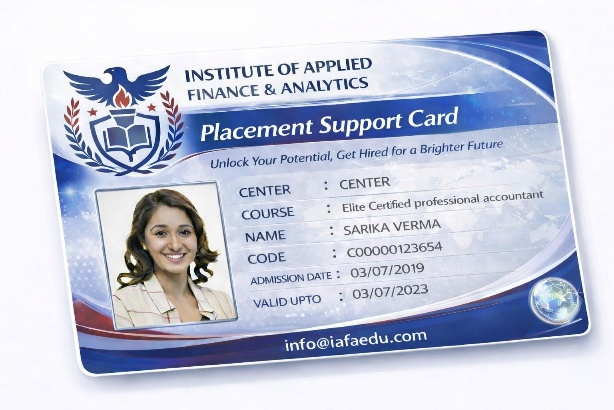
Who Should Enroll in the Accounting Course?
The accounting course perfectly fits those, who are passionate about learning accounts and moving a career ahead in the accounting industry:
- One who is interested in learning accounts or managing their business accounts.
- People who have already completed B.COM, or M.COM or have basic accounting knowledge.
- Open an opportunity for CAs, CSs, and Tax practitioners to join accounting classes for advanced learning.
What You Will Master in the Certificate Course On Accounting
- Business Computer Applications (BCA):The accounting class begins with the basic concept of BCA and teaches you about hardware, software, number & conditional formatting, and Database design. This basic accounting process creates a strong base for the future.
- Accounting Fundamentals:This module teaches you the core accounting concepts. The complete section targets everything from fundamentals to bookkeeping systems, Stock Valuation, and depreciation.
- Financial Statement Creation:Learn how to prepare key financial statements like the Income Statement, Balance Sheet, and Cash Flow Statement. Use this knowledge to share valuable insights about the company’s financial health in the workplace.
- Tally Prime Software:Unlock the opportunity to learn the most powerful accounting software. Get practical exposure to tasks like managing TDS, Payroll processing, Inventory Management, and GST return.
- Business Communication Skills:Effective communication is a key to success in any profession. These modules boost your accounting expertise by preparing you for an interview and future job interactions.
- Direct Taxation System:This module helps you to learn about income tax, filing procedures, tax law, and more. The module is completely scenario-based for in-depth understanding and better learning exposure.
- Mastering GST:Deep dive into the world of GST from its basic concept to return. Even learn the GST using Tally Prime to manage GST effectively.
- Advanced Accounting Techniques:Improve your skill sets with this section by learning accounts reconciliation, journal entries, and more. This ensures you manage accurate financial records efficiently.
Certification
After getting certified in an accounting course, several career opportunities await the aspiring candidates to join. To get the right skill set, invest in your future now. Join the Accounting Certification Program today!
Career Opportunities After Certification
After joining the accounting classes and completing the course, candidates can apply for the following job openings:
- Public Accountant
- Internal Auditor
- Tax Accountant
- Financial Analyst
- Bookkeeper
- Accounting Clerk
- Accountant Manager
- Financial Advisor
Eligibility Criteria
Pre-Requisites for Joining this Course:
- Education:
- Completed Higher Secondary (Class 12)
- Pursuing Graduation to Complete or Completed
- Devices:Access to desktop or laptop with stable internet connection (as classes are practically oriented)
- CET:Must clear common entry test conducted by Institute of Applied Finance & Analytics (IAFA)
- For more details – please connect with Career Coach at Institute of Applied Finance & Analytics (IAFA)

Highlights
- Practical & Industry-Oriented Training
- Tally Prime with GST & Compliance
- Income Tax & GST Return Filing
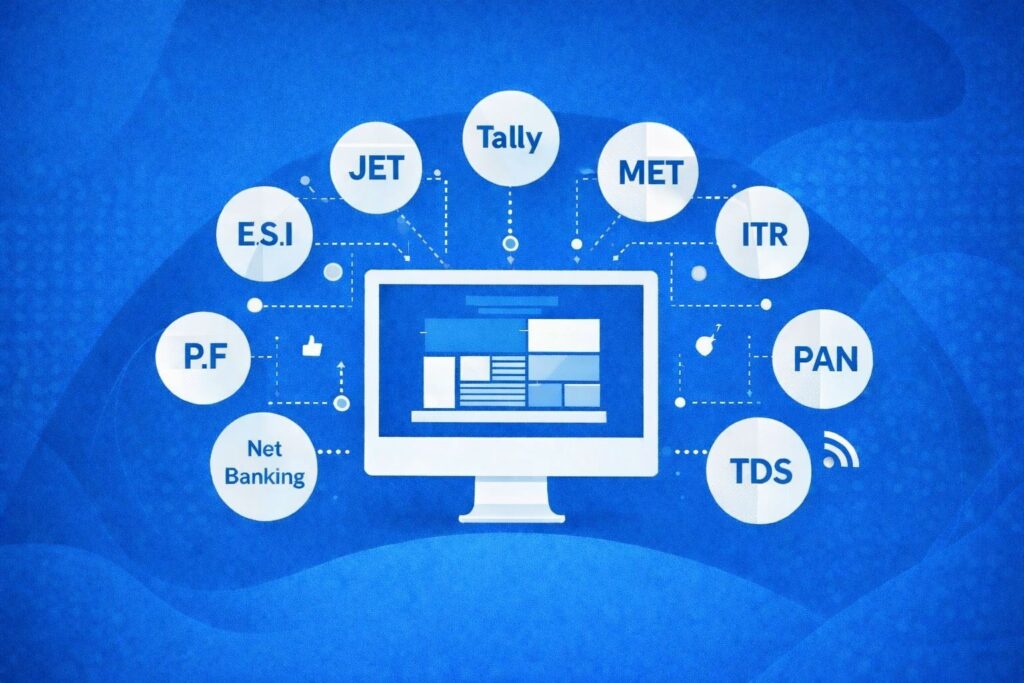
- Payroll, PF, ESI & Labour Compliance
- Real-Time Accounting Projects
- Corporate & CA-Firm Level Exposure
- 100% Job-Ready Skill Development
Career Opportunities After Certification
After joining the accounting classes and completing the course, candidates can apply for the following job openings:
- Public Accountant
- Internal Auditor
- Tax Accountant
- Financial Analyst
- Bookkeeper
- Accounting Clerk
- Accountant Manager
- Financial Advisor
Syllabus Overview
Module 01: Business Computer Applications
Institute of Applied Finance & Analytics
Duration: 48 Hours
Total Lectures: 10 Lectures
Builds essential computer skills required for accounting, finance, and corporate work environments.
- Hardware & Software
- Working with Windows 10
- File & Folder Management
- Introduction to MS Word 2021
- Page Setup
- Tables
- Header & Footer
- Number & Conditional Formatting
- Database design
- Drafting and Formatting Documents
- Introduction to MS Excel 2021
- Custom List
- Format Painter
- Cell Reference
- Filling Series
- Name Range
- Understanding Formula
- Date Functions
- Data Validation
- Look up & Reference Functions
- Logical Functions
- Financial Functions
- Scenario Manager
- Goal Seek
- Solver
- Chart
- Sort & Filter
- Pivot Table & Pivot Chart
- Slicers & Timelines
- Subtotal
- Tracing cell
- Consolidating
- Text to column
- Concept of Array
- Importing data
- Sparkling
- Quick Analysis
- Splitting
- Freeze Panes
- Track Changes
- Protection
- Page Set up and Printing
- Project on Excel
- MS PowerPoint 2021
- MS Outlook 2021
- Internet & E-mail Writing
- Mail Merge
- G- Suite
- AI use in MS Excel
Module Benefit
Business Computer Application (BCA) module helps the student to understand the use of standard software programs used in workplace.
Learning Outcomes:
- Organizing data, structuring, and reporting
- MIS using spreadsheets
- Writing e-mails and drafting various documents
- Management Presentation
- Digitizing of stand
Module 02: Business Accounting
Institute of Applied Finance & Analytics (IAFA)

Duration: 36 Hours
Total Lectures: 12 Lectures
This module builds a strong foundation in accounting principles and practical bookkeeping, enabling students to understand, record, and present financial information accurately as per industry standards.
Curriculum Structure
Lecture 1: Fundamentals of Accounting
Overview of accounting, objectives, scope, and its role in business decision-making.
Lecture 2: Core Accounting Principles & Concepts
Accounting assumptions, concepts, conventions, and standards applied in real business scenarios.
Lecture 3: Capital vs. Revenue Transactions
Identification, classification, and accounting treatment of capital and revenue items.
Lecture 4: Accounting Documents & Source Records
Understanding vouchers, invoices, debit/credit notes, receipts, and supporting documents.
Lecture 5: Journal Entries & Ledger Posting
Double-entry system, journalizing transactions, and posting into ledger accounts.
Lecture 6: Depreciation Accounting
Methods of depreciation, calculation, accounting entries, and impact on financial statements.
Lecture 7: Inventory & Stock Valuation
Valuation methods, cost determination, and treatment of closing stock.
Lecture 8: Year-End Adjustments
Outstanding expenses, prepaid income, provisions, accruals, and adjustments before finalization.
Lecture 9: Preparation of Final Accounts
Trading Account, Profit & Loss Account, and Balance Sheet preparation.
Lecture 10: Rectification of Accounting Errors
Identification and correction of errors through rectification entries.
Lecture 11: Bank Reconciliation Statement (BRS)
Preparation and analysis of BRS to reconcile bank and cash balances.
Lecture 12: Practical Project & Assessment
Hands-on project on preparation of complete books of accounts along with Online Journal Entry Test (JET).
Module Benefits
- Strong understanding of accounting fundamentals used in real business environments
- Ability to record, classify, and summarize financial transactions accurately
- Practical exposure to journal entries, ledger posting, and final accounts preparation
- Hands-on experience with bank reconciliation and error rectification
- Improved accuracy and compliance in financial reporting
- Job-ready skills for Accounts Executive, Accounts Assistant, and Accounting Officer roles
- Performance evaluation through Online Journal Entry Test (JET)
Module 03: Tally Prime (with GST, TDS & Payroll)
Institute of Applied Finance & Analytics (IAFA)

Duration: 51 Hours
Total Lectures: 15 Lectures
This module provides end-to-end practical training on Tally Prime, enabling students to manage complete accounting operations, statutory compliances, payroll, and reporting as used in real business environments.
Curriculum Structure
Lecture 1: Company Creation & Configuration
Creation of company, selection of features, statutory settings, and financial year configuration.
Lecture 2: Cost Centres & Cost Categories
Allocation and tracking of costs for departments, projects, and profitability analysis.
Lecture 3: Core Accounting Operations
Ledger creation, voucher entries, bill allocation, banking transactions, and day-to-day accounting.
Lecture 4: Inventory Management
Stock groups, units of measurement, godowns, stock items, valuation methods, and inventory control.
Lecture 5: Bill of Materials (BOM)
Manufacturing setup, consumption tracking, and production accounting using BOM.
Lecture 6: Purchase & Sales Cycle
Complete purchase and sales workflow including orders, invoices, returns, credit/debit notes.
Lecture 7: Fundamentals of GST
GST concepts, tax structure, applicability, registration basics, and compliance overview.
Lecture 8: GST Accounting using Tally
GST master creation, intra/inter-state transactions, reverse charge, and GST entries.
Lecture 9: GST Return Generation
Preparation and generation of GST returns and reconciliation reports using Tally.
Lecture 10: TDS Accounting & Compliance
TDS deduction, challan payment, returns, certificates, and statutory reporting.
Lecture 11: PF & Statutory Payroll
Employee master creation, salary structure, PF calculations, and compliance reporting.
Lecture 12: Data Backup & Restore
Backup management, data security, restoration techniques, and best practices.
Lecture 13: Payroll Processing
End-to-end payroll processing including salary computation, payslips, and statutory deductions.
Lecture 14: Security & User Controls
User access control, security features, audit trail, and data protection.
Lecture 15: Reports & MIS Analysis
Financial statements, GST reports, inventory reports, payroll reports, and MIS dashboards.
Module Benefits
- Hands-on experience with complete end-to-end accounting using Tally Prime
- Ability to manage day-to-day accounting transactions independently
- Practical understanding of GST and TDS compliance
- Proficiency in payroll processing and statutory deductions (PF, TDS)
- Strong command over inventory and cost management
- Expertise in financial reporting and MIS generation
- Job-ready skills for Accounts Executive, Tally Operator, and GST Executive roles
Module 04: Business Communication & Professional Skills
Institute of Applied Finance & Analytics (IAFA)

Duration: 45 Hours
Total Lectures: 9 Lectures
This module is designed to develop effective communication, interpersonal, and workplace
skills essential for success in professional accounting, finance, and corporate environments.
Curriculum Structure
Lecture 1: Assertive Communication
Develop confident, clear, and respectful communication to express ideas professionally.
Lecture 2: Non-Verbal Communication
Understanding body language, gestures, posture, and professional presence in the workplace.
Lecture 3: Presentation & Public Speaking Skills
Structured presentations, confidence building, and professional delivery techniques.
Lecture 4: Interview Skills & Professional Conduct
Interview preparation, answering techniques, and corporate etiquette.
Lecture 5: Personal Branding – Selling Your Skills
Identifying strengths, showcasing skills, and positioning yourself effectively in the job market.
Lecture 6: Resume & Cover Letter Writing
Professional resume structuring, cover letter drafting, and job-application best practices.
Lecture 7: Workplace Behaviour & People Skills
Teamwork, professional ethics, workplace conduct, and interpersonal effectiveness.
Lecture 8: Business Email & Corporate Etiquette
Professional email writing, tone, structure, and digital communication standards.
Lecture 9: Goal Setting & Time Management
Planning techniques, productivity tools, prioritization, and performance management.
Module Benefits
- Strong improvement in communication and behavioral skills
- Increased confidence in interviews, presentations, and meetings
- Ability to write professional resumes, cover letters, and business emails
- Enhanced workplace etiquette and team collaboration skills
- Improved time management and productivity
- Better professional image and leadership readiness
- Essential soft skills required for corporate and client-facing roles
Module 05: Direct Tax (Income Tax & TDS)
Institute of Applied Finance & Analytics (IAFA)

Duration: 39 Hours
Total Lectures: 10 Lectures
This module provides in-depth practical knowledge of Income Tax laws and TDS
compliance, enabling students to compute taxable income, file returns, and handle statutory
responsibilities as per current regulations.
Curriculum Structure
Lecture 1: Fundamentals of Income Tax
Introduction to income tax, basic concepts, assessment year vs. previous year, and overview of tax structure.
Lecture 2: Income from Salaries
Salary components, allowances, perquisites, deductions, and computation of taxable salary income.
Lecture 3: Income from House Property
Taxability, computation of annual value, deductions, and treatment of self-occupied and let-out properties.
Lecture 4: Profits & Gains from Business or Profession
Business income computation, allowable expenses, depreciation, and maintenance of books of accounts.
Lecture 5: Capital Gains & Income from Other Sources
Short-term and long-term capital gains, exemptions, and taxation of residual income sources.
Lecture 6: Deductions under Chapter VI-A
Section-wise deductions including 80C, 80D, 80G, and other applicable tax-saving provisions.
Lecture 7: Computation of Taxable Income & Tax Liability
Step-by-step computation of total income, tax payable, surcharge, and cess.
Lecture 8: PAN, ITR Filing & TDS Concepts
PAN application, online filing of Income Tax Returns, and introduction to TDS provisions.
Lecture 9: E-TDS & Statutory Compliance
TDS deduction, challan payment, e-TDS return filing, Form 26Q/24Q, and compliance requirements.
Lecture 10: Practical Project on TDS
Hands-on project covering TDS calculation, return filing, and compliance documentation.
Module Benefits
- Strong understanding of Income Tax laws and practical applications
- Ability to compute taxable income and tax liability independently
- Hands-on experience in Income Tax Return (ITR) filing
- Practical exposure to TDS deduction, payment, and e-TDS returns
- Improved statutory compliance knowledge as per current tax regulations
- Job-ready skills for Tax Executive, Accounts Executive, and Junior Tax Consultant roles
- Real-world application through practical TDS project work
Module 06: Goods & Services Tax (GST)
Institute of Applied Finance & Analytics (IAFA)

Duration: 27 Hours
Total Lectures: 9 Lectures
This module provides comprehensive practical knowledge of Goods & Services Tax (GST),
enabling students to understand GST law, perform GST compliance, work on the GSTN
portal, and handle GST accounting using Tally.
Curriculum Structure
Lecture 1: Fundamentals of GST
Introduction to GST, objectives, structure, scope, and key terminologies.
Lecture 2: Levy & Collection of GST
Understanding taxable events, chargeability, types of GST, and responsibility for tax collection.
Lecture 3: Valuation under GST
Determination of taxable value, inclusions, exclusions, and valuation rules.
Lecture 4: Payment of GST
Computation of GST liability, utilization of Input Tax Credit (ITC), and payment procedures.
Lecture 5: Input Tax Credit (ITC) Mechanism
Eligibility, conditions, utilization, reversal, and restrictions of ITC.
Lecture 6: GST Returns & Compliance
Types of GST returns, due dates, filing procedures, and compliance requirements.
Lecture 7: GST Accounting using Tally
GST configuration, transaction entries, reports, and reconciliation using Tally.
Lecture 8: Practical Training on GSTN Portal
Hands-on practice on registration, return filing, challans, and GST portal navigation.
Lecture 9: Practical Project on GST
Live project covering GST return filing, reconciliation, and compliance documentation.
Module Benefits
- Clear understanding of GST law and compliance framework
- Ability to compute GST liability and manage Input Tax Credit (ITC)
- Practical exposure to GST return filing and GSTN portal operations
- Hands-on experience with GST accounting using Tally
- Strong compliance skills aligned with current GST regulations
- Job-ready expertise for GST Executive, Tax Associate, and Accounts Executive roles
- Real-world learning through GST practical project work
Module 07: Advanced Accounting & Financial Analysis
Institute of Applied Finance & Analytics (IAFA)

Duration: 30 Hours
Total Lectures: 6 Lectures
This module focuses on advanced accounting practices and financial statement analysis, enabling learners to handle complex accounting scenarios, digital transactions, and end-to- end finalisation of accounts in real corporate environments.
Curriculum Structure
Lecture 1: Accounts Reconciliation
Reconciliation of debtors, creditors, banks, branches, and inter-ledger balances to ensure accuracy.
Lecture 2: Advanced Journal Entries
Treatment of complex accounting entries including provisions, depreciation, accruals, and adjustments.
Lecture 3: Accounting for Digital Transactions
Accounting treatment for credit cards, debit cards, UPI, wallets, and online payment gateways.
Lecture 4: Company Final Accounts
Preparation of company financial statements including Profit & Loss Account and Balance Sheet.
Lecture 5: Online Finalisation of Accounts
Practical approach to closing books of accounts using accounting software and online systems.
Lecture 6: Financial Statement Analysis
Analysis of financial statements using ratios, trends, and performance indicators for decision-making.
Module Benefits
- Strong command over advanced accounting concepts and practices
- Ability to reconcile accounts and detect discrepancies accurately
- Practical understanding of digital and electronic transaction accounting
- Expertise in company finalisation of accounts
- Skills to analyse financial statements for business insights
- Job-ready capabilities for Accounts Officer, Senior Accounts Executive, and Finance
Analyst roles
- Enhanced accuracy, compliance, and reporting confidence in corporate environments
Module 08: Additional Applied Accounting Program
Busy
What They Say
Students Testimonial.
“IAFA’s practical training helped me understand real-world accounting, GST, and Tally operations. The structured learning and live projects made me confident to work independently.”
List of Potential Recruiters